
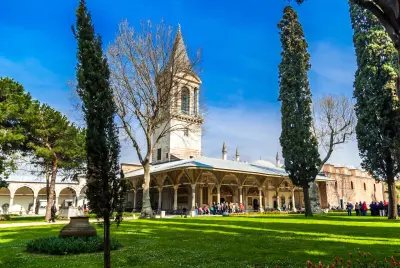
TOPKAPI PALACE ARCHITECTURE
A window into Ottoman opulence
Topkapi Palace, located in the heart of Istanbul, is a remarkable example of 15th-century Ottoman architecture. It combines Byzantine, Ottoman, and Islamic influences, creating a unique architectural look highlighting the Ottoman Empire’s wide cultural influences and artistic creativity.
Construction of the palace began in 1459 after Sultan Mehmed II captured Constantinople, and it lasted for much of his reign, resulting in a complex of buildings, courtyards, and gardens. The palace served as the administrative, ceremonial, and residential center of the Ottoman Empire. Today, as a UNESCO World Heritage Site, Topkapi Palace is open to the public and continues to attract millions of visitors, offering insight into the rich history, culture, and architectural masterpiece of the Ottoman Empire.

A harmonious design of function and style
Topkapi Palace is a complex of buildings designed for various purposes, arranged around large courtyards lined with colonnades. Inspired by the earlier Ottoman palaces like the Edirne palace, the layout of the palace grounds includes stone service buildings with high domes and residential buildings made of stone and wood with lead-covered domes.
Surrounding the palace is the Sur-ı Sultanî, a high wall that separates it from the outside world. This wall contains three main gates and five smaller service gates. The palace gardens, decorated with fountains, pools, and water reservoirs, stretch from the hilltop down to the sea. The gardens feature geometric designs that reflect the Islamic love of nature and the idea of paradise gardens.

Courtyards and gates
The palace is divided into four main sections: the Bîrun (Outer Palace) with service buildings and guard posts, the Dîvân-ı Hümâyun (State Council), the Enderûn (Palace School), and the Harem, with the Sultan’s private residence. The ceremonial part of the palace consists of three courtyards connected by three key gates. The Bâb-ı Hümayun (Royal Gate) opens onto the Alay Meydanı (First Courtyard), the public area. The Bâbüsselâm (Gate of Salutation) leads to the Divan Meydanı (Second Courtyard), which is home to the main palace buildings. The Bâbüssaâde (Gate of Felicity) opens into the Enderûn Meydanı (Third Courtyard), where the palace school and the Sultan’s private quarters are located. Despite changes over time, particularly in the gardens, the palace’s main layout and symbolic structure remain unchanged.

Main entrance
The main road to Topkapi Palace is Divan Yolu, which was once used for imperial processions. The Imperial Gate, built in 1478 and later updated with marble in the 19th century, has a domed passage with Quranic verses and symbols of Sultans Mehmed II and Abdulaziz. Previously, a wooden apartment above the gate served various functions, including a pavilion, a storage area for the belongings of deceased residents without heirs, and a viewing spot for harem women during special events.
The first courtyard
The first courtyard, called Alay Meydanı (Procession Square), is an open space surrounded by important buildings like the Church of Saint Eirene, the Mint, the Bakeries, the Hospital, Firewood Storage, and the Reed Mat Makers’ building, where mats for palace floors were woven. Architecturally simple, it serves as the palace entrance and provides access to the imperial complex. The courtyard reflects a practical Ottoman style influenced by Byzantine design, with service buildings made of stone and a focus on accessibility and utility. The Bâb-ı Hümâyun, a grand two-story gate with a calligraphic inscription, leads into the first courtyard. From there, the Bâbüsselâm (Gate of Greeting) opens to the second courtyard, followed by the Bâbüssaâde (Gate of Felicity), which leads to the third courtyard and then the fourth, each surrounded by buildings and gardens.

The second courtyard
The second courtyard of Topkapi Palace, Divan Square or Justice Square, is designed in the classical Ottoman style, focusing on symmetry and hierarchy. This courtyard is accessed through the Gate of Salutation (Bâbüsselâm), a grand gate with two pointed towers that serves as the formal entrance and marks the transition from the public first courtyard to the more restricted and ceremonial second courtyard. The courtyard includes decorative domes, arches, colonnades, and gardens, highlighting its ceremonial role. It was the administrative center of the palace, hosting ceremonies and housing important buildings like the Council Chamber (Kubbealtı or Divan-ı Hümâyûn), where the Council of State met, and the State Treasury. Behind the Council Chamber was the Tower of Justice, symbolizing the sultan’s power.
The second courtyard also contained army barracks, halls, stables, and kitchens. Today, the kitchens display an imperial porcelain collection, and the External Treasury presents imperial weapons. These items, made in palace workshops or acquired through gifts or conquest, reflect the empire’s vast reach, including Chinese celadon, which was believed to detect poison.

The third courtyard
The third courtyard of Topkapi Palace is a good example of classical Ottoman architecture, with symmetrical layouts, decorative domes, intricate tiles, and arabesque designs. The Gate of Felicity leads to this courtyard, which was reserved for the sultan, his family, and approved visitors.
The courtyard is surrounded by important buildings, such as the Sultan’s Audience Chamber, Falconers’ Hall, Enderun Treasury, and the Palace School, all built in the Ottoman style. To the right is the Pavilion of the Conqueror, and to the left is the Privy Chamber, a four-domed structure next to the Harem. Originally called the Apartment of the Holy Mantle, it housed sacred relics brought by Sultan Selim I. The Chamber of Holy Relics once held the Sultan’s apartments, and the courtyard also included dormitories for royal pages, with both functional and decorative architecture. Today, the dormitories display imperial collections, including 19th-century European-inspired portraits and clothing, reflecting the palace’s cultural influences.
Learn more about the architecture of the Topkapi Palace!

Access to Harem
Topkapi Palace Small-Group Tour
Skip the line at the Topkapi Palace and explore its many rooms with an expert local guide! You can see where the Ottoman imperial families lived, a collection of weapons, armor, and jewels at the treasury, stunning architecture, and much more. Your guide will tell you about Turkey's history and historical figures such as Sultan Suleyman the Magnificent and his wife, Hürrem.

Visit the palace & the harem
Topkapi Harem Tour
Visit the Harem at the Topkapi Palace with skip-the-line access and an expert guide who will share stories about the royal family and Ottoman culture, such as the hierarchy of the dozens of Ottoman sultans' concubines. Access to the Topkapi Palace is included, too, and you can make this a private experience!

Harem and courtyard of the Sultan’s consorts and concubines
The Harem, located in the third courtyard, was the private residence of the Sultan and his family. The Valide Court, or Courtyard of the Queen Mother, is centrally located and renowned for its stunning tile work, which is thought to feature both Iznik and European influences, including from 17th-century Vienna or Italy. The Courtyard of the Sultan’s Consorts and Concubines, built in the mid-16th century and restored after the 1665 fire, is the smallest in the Harem. It is surrounded by baths, dormitories, and the chief consort’s apartments. Three tiled apartments overlooking the Golden Horn were for the consorts, with 18th-century frescoes showing Western influence. A staircase, the “Forty Steps”, leads to the Harem Hospital, concubine dormitories, and gardens. The “Golden Road” near the Valide compound leads to the “Courtyard of the Black”, where eunuchs lived, with vibrant tile decorations, apartments, a mosque, and baths.

Grilled windows
Grilled windows can be found in several areas of Topkapi Palace, particularly in the Harem, Sultan’s private quarters, and other restricted sections. These windows were designed to provide ventilation while maintaining privacy and security, often with intricate ironwork. The windows were also used in places where women of the Harem would look out without being seen, contributing to the overall sense of privacy and separation in those areas.
Throne rooms, relics, and wealth
The third courtyard of Topkapi Palace features key royal buildings like the Hunkar Sofasi, or throne room, built by Selim I, which is decorated with luxurious Rococo tiles and furniture. The nearby Saloon of Murad III has a beautiful dome, arabesque patterns, and Quranic verses. The Library of Sultan Ahmed III, now part of the mosque, displays important manuscripts. The Imperial Treasury exhibits the empire’s wealth, while the Chamber of Sacred Relics houses items like the Prophet Muhammad’s hair and a Quran from Caliph Uthman. The northern wing contains the Palace School, and the Ottoman Pavilion, or Fatih Pavilion, highlights Ottoman grandeur with its architecture and treasures.

The fourth courtyard
The fourth courtyard of Topkapi Palace features several royal pavilions, including the İftariye Gazebo, Baghdad Pavilion, and Revan Pavilion, all examples of Ottoman architectural influence. This area is known for relaxation and leisure, with a Tulip Garden, terraces, kiosks, and the Sunnet Odası, a tiled pavilion in the Tulip Garden known for its 16th-century Iznik tiles.
The Sofa Pavilion, built in the 18th century, blends Ottoman and European styles with Baroque influence and includes couplets by poet Hâkânî Mehmed Bey. Ambassadors and politicians were occasionally received there. Nearby is the Stone Tower, which was once used as the palace pharmacy. The lower part of the courtyard contains the Mecidiye Pavilion and the Wardrobe Chamber, the last buildings added to the palace.
The Turkish influence
The Turkish influence on Topkapi Palace is reflected in its layout, which includes a series of courtyards surrounded by chambers and halls, following traditional Turkish architectural styles. This includes focusing on spreading out horizontally rather than building upwards and features like tiled roofs and wooden facades.

The Byzantine influence
The Byzantine influence on Topkapi Palace can be seen in its design, with large domes and open courtyards inspired by Byzantine architecture in Constantinople, adapted to Ottoman style. In the first courtyard, Hagia Eirene, once a Byzantine church and later an Ottoman armory, has a plain brick facade typical of Byzantine design. Nearby, the Gate of Salutation, or Middle Gate, looks like a medieval European fortress with its pointed towers and notched walls.
The Persian influence
The Persian influence on Topkapi Palace is evident in its detailed tile work, vibrant colors, and decorative patterns. Acem Ali, a Persian artist who worked in the Ottoman court during the reign of Sultan Süleyman the Magnificent, created many detailed miniatures presenting historical events and royal life. His work blended Persian and Ottoman artistic styles and can be seen in the Topkapi Palace Museum as part of the palace’s collection. The palace gardens, with their symmetrical layouts and water features, are also inspired by Persian garden designs. The spacious courtyards and pavilions also reflect a blend of Persian and Ottoman architectural styles.
The Islamic influence
The Islamic influence on Topkapi Palace is clear in its use of geometric patterns and arabesque designs, which are common in Islamic art. The palace’s layout, which prioritizes privacy and hierarchy, and the presence of several mosques within the complex, including the Privy Chamber, also reflect Islamic architectural principles.
Want to explore Topkapi Palace at your own pace?

Skip-the-line
Topkapi Palace and Harem Ticket
Visit the Topkapi Palace, enter the Harem, and skip the line to explore at your own pace with this two-in-one ticket! It includes an audio guide full of interesting stories about life at the palace, its architecture, and the Ottoman Empire. Your ticket is valid for 1 day, so you don't have to rush, and a host will help you at the entrance.

Guided tour included
Istanbul Museum Pass
Gain access to 5 top attractions in Istanbul! Visit Topkapi Palace, Hagia Sophia, the Blue Mosque, the Basilica Cistern, and more. Your pass is valid for 3 days, giving you the freedom to explore the city however you'd like. This ticket also includes guided tours led by experts. Choose between a private or shared group experience.