
TOPKAPI PALACE HISTORY
About Topkapi Palace
Topkapi Palace, located in the heart of Istanbul, was the administrative center and main residence of the Ottoman sultans from the 1460s until 1856. Built by Sultan Mehmed the Conqueror, the construction began in 1459 after the conquest of Constantinople, and was completed in 1465. Over time, other sultans added buildings, creating the large complex seen today.
After the fall of the Ottoman Empire, Topkapi became a museum in 1924, at the request of Turkey’s first President, Mustafa Kemal Atatürk. Today, it is now managed by Turkey’s Ministry of Culture and Tourism. The palace is part of the Historic Areas of Istanbul, a UNESCO World Heritage Site. Today, the palace is open for visitors to explore important sections, including the Harem, Imperial Treasury, and museum collections.

How Topkapi Palace got its name
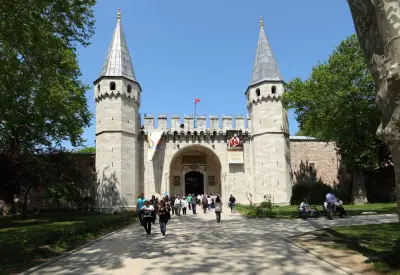
The palace was originally called Saray-i Cedid-i Amire, meaning “Imperial New Palace”, to distinguish it from the earlier Beyazit Palace, a name it kept until the 18th century. During the reign of Mahmud I, the name was changed to Topkapi after the seaside palace, Topkapusu Sâhil Sarâyı, was destroyed by fire. In Turkish, Topkapi means “Cannon Gate”.
The palace served as the Sultan’s residence and government center until the 1840s when Dolmabahçe Palace was built to meet modern needs.

A strategic location overlooking the Bosphorus
The palace complex is situated on Istanbul’s historic peninsula, surrounded by the Marmara Sea, Bosphorus Strait, and Golden Horn. The site, once called Zeytinlik (Olive Grove), began with gardens and pavilions surrounded by walls known as Sûr-ı Sultânî. The palace is located at one of the highest points on the hill, offering strategic views of the sea and Istanbul’s skyline. It covers around 700,000 m² at Sarayburnu, the site of the former Eastern Roman Byzantine acropolis of the ancient Greek city Byzantion (which later became Constantinople and then Istanbul). The site includes courtyards, gardens, and various buildings. It served as the Sultan’s official residence until the mid-19th century when, in 1856, Dolmabahçe Palace became the new home, though Topkapi continued to hold its historical and symbolic significance.

Sultan Mehmed II’s vision for Topkapi Palace
After Sultan Mehmed II conquered Constantinople in 1453, the Great Palace of Constantinople was in ruins. The Ottoman court was first established in the Old Palace (Eski Saray) at Istanbul University in Beyazit Square. In 1459, Sultan Mehmed II ordered the construction of Topkapi Palace. The historian Critobulus of Imbros reported that the Sultan brought the best workers, including masons, carpenters, and stonecutters, to create grand buildings. The exact dates for the construction of the palace’s inner core vary. Some sources mention 1459-1465, while others suggest it was completed in the late 1460s.

How Topkapi Palace protected royal privacy
Sultan Mehmed II designed the layout of Topkapi Palace, placing his private quarters at the highest point. The palace, surrounded by high walls (some from the Byzantine period), included many buildings and pavilions stretching down to the Bosphorus. This layout influenced future renovations. Topkapi differed from other European and Islamic palaces, with European visitors calling it “irregular, asymmetric, and un-monumental”, while the Ottomans referred to it as “The Palace of Felicity”. The palace followed the principle of imperial seclusion, established by Mehmed II in 1477 and 1481. This meant silence was enforced in the inner courtyards, and the design included grilled windows and secret passageways to ensure privacy for the sultan and his family.

The rise and transformation of the Sultan’s palace
Other sultans made changes to the palace, but Mehmed II’s original layout was mainly kept. The palace was greatly expanded between 1520 and 1560 during Suleyman the Magnificent’s reign as the Ottoman Empire grew. The leading architect at this time was the Persian Alaüddin, also known as Acem Ali, who also worked on expanding the Harem. In 1574, after a fire destroyed the kitchens, Sultan Selim II assigned Mimar Sinan to rebuild the damaged parts. Sinan not only repaired the damaged areas but also expanded the Harem, baths, Privy Chamber, and seaside pavilions.

Beyond the Imperial walls
The Topkapi Palace expanded over the centuries, undergoing significant renovations following the 1509 earthquake and the 1665 fire. By the late 16th century, the palace had evolved into its present form, a vast complex of low-rise buildings arranged around four courtyards and linked by galleries. Key areas of the palace include the Harem, home to the Sultan’s family; the Imperial Treasury, which holds a collection of jewels and treasures; the Sacred Relics chamber, containing religious artifacts; the palace kitchens, which showcase culinary traditions; and the Sultan’s Council Chamber, where important decisions were made. The palace also contains beautiful pavilions and courtyards decorated with intricate tile panels and offering panoramic views. Within the complex, near the outer courtyard, is Hagia Eirene, a historic Byzantine church now serving as a museum and concert hall.
Discover Topkapi Palace on our guided tours!

Access to Harem
Topkapi Palace Small-Group Tour
Skip the line at the Topkapi Palace and explore its many rooms with an expert local guide! You can see where the Ottoman imperial families lived, a collection of weapons, armor, and jewels at the treasury, stunning architecture, and much more. Your guide will tell you about Turkey's history and historical figures such as Sultan Suleyman the Magnificent and his wife, Hürrem.

Customizable tour
Topkapi Palace Private Tour
Book our Topkapi Palace Private Tour and explore the seat of the Ottoman Empire in style! A private guide will lead you through the palace complex, showing you terraced gardens, the treasury, the armoury, and more. With the guide’s full attention on you, you’ll enjoy a true VIP experience!

Inside the Harem: power, politics, and intrigue
The Harem was a private part of the palace and the residence where the Sultan’s family, including wives, concubines, and children, lived, along with many eunuchs. This area was a place of political intrigues and power struggles, playing a significant role in influencing and shaping the governance and state affairs of the empire through family connections and rivalries. This quarter includes several courtyards, gardens, baths, and living spaces, with the Valide Court (Courtyard of the Queen Mother) as the central area. Valide, the Sultan’s mother, had an important role in managing the Harem.

Power, art, and education
The palace hosted grand state functions, including the accession ceremonies of new sultans, royal weddings, and important diplomatic receptions, strengthening the Sultan’s power and authority. Topkapi Palace was also a center for learning and the arts, with the Imperial Treasury filled with jewels and rare artifacts and the Palace Library and School, where princes and courtiers were trained in administration, arts, and military strategy.

Inside Topkapi Palace
The Middle Gate leads into the palace, consisting of four main courtyards, passing through the Courtyard of the Black Eunuchs. Other areas include the Circumcision Room (Sünnet Odası), the Tower of Justice, the Imperial Council Chamber, and the Cannon Gate, a grand entrance.
The first courtyard was open to visitors, while the fourth courtyard and the Harem, heavily guarded by high walls and gates, were highly restricted. The complex also features smaller courtyards and stretches to 592,600 to 700,000 m². Gülhane Park borders the complex to the west and south. The fifth courtyard, once filled with summer palaces and pavilions, has largely disappeared due to neglect and 19th-century railroad construction. The only remaining building is the Basketmakers’ Kiosk, built in 1592 by Sultan Murad III.

From Royal palace to historic treasure
After the 17th century, Topkapi lost its significance as sultans preferred spending time in new palaces along the Bosphorus. In 1856, Sultan Abdulmejid I moved the court to the newly built Dolmabahçe Palace, though Topkapi still held some functions, including the Imperial Treasury, library, and mint. Topkapi Palace, no longer the center of imperial life, continued symbolizing the Ottoman Empire’s rich heritage and grandeur.

Conversion to a museum
On April 3, 1924, after the Republic of Turkey was founded in October 1923, Topkapi Palace became the first museum of the Republic, by the order of Mustafa Kemal Atatürk. This marked a new era in its history, preserving its heritage and opening its doors to the public, allowing people from around the world to explore its history and treasures. Today, the entire site stretches over nearly 350,000 m², excluding Gülhane Park, which was once part of its gardens and is now a public park. With historic buildings, collections, and 300,000 archive documents, it is one of the largest museum-palaces in the world.

From robbery to terror threats
The palace has faced criticism for its lack of security and preservation, with experts warning that it has no climate-controlled rooms or proper storage. The palace largely avoided damage during the 1999 İzmit earthquake because many of its walls were 3 meters thick. After the earthquake, the preservation of the porcelain collection was improved. In 1999, thieves stole parts of a 12th-century Qur’an from a locked exhibit in the library. In 2011, Samir Salem Ali Elmadhavri, a Libyan man, attempted to attack tourists at the palace. He was stopped by palace guards at the entrance, but then opened fire, injuring two people. After entering the main courtyard, he was eventually eliminated by Turkish police.
Topkapi Palace today
Today, Topkapi Palace Museum is managed by Turkey’s Ministry of Culture and Tourism. While the palace has hundreds of rooms, only key areas, like the Imperial Harem and the Imperial Treasury, are open to the public. The Treasury displays items like the Spoonmaker’s Diamond and the Topkapi Dagger. The museum’s collection includes Ottoman clothing, weapons, armor, miniatures, religious relics, and manuscripts like the Topkapi manuscript. The complex is guarded by ministry officials and Turkish military forces. In 1985, it became part of the Historic Areas of Istanbul, a UNESCO World Heritage Site.
Want to find out more about the Topkapi Palace and its history?

Visit the palace & the harem
Topkapi Harem Tour
Visit the Harem at the Topkapi Palace with skip-the-line access and an expert guide who will share stories about the royal family and Ottoman culture, such as the hierarchy of the dozens of Ottoman sultans' concubines. Access to the Topkapi Palace is included, too, and you can make this a private experience!

Skip-the-line
Topkapi Palace and Harem Ticket
Visit the Topkapi Palace, enter the Harem, and skip the line to explore at your own pace with this two-in-one ticket! It includes an audio guide full of interesting stories about life at the palace, its architecture, and the Ottoman Empire. Your ticket is valid for 1 day, so you don't have to rush, and a host will help you at the entrance.